QCELLS vs Canadian Solar: Budget Panel Brands Compared
Choosing between QCELLS and Canadian Solar comes down to a handful of factors that actually affect your bill and your roof: efficiency, degradation, warranty terms, and price per watt. Both are among the best solar panel manufacturers in the world, and both build high-quality solar panels that hold up under real-world conditions, but they take different approaches to get there.
This guide walks through how QCELLS and Canadian Solar compare on technology, performance, durability, warranty, price, and reputation, so homeowners, installers, and commercial buyers can decide which panel brand fits their project.
Brand Overviews: Canadian Solar vs QCELLS
QCELLS, formally Hanwha QCELLS, has manufacturing facilities in South Korea and has been a major name in the solar industry since 2001. The company is known for its Q.ANTUM cell technology and Q.PEAK product line, and it has built a reputation for reliability among residential solar installers in the US and Europe.
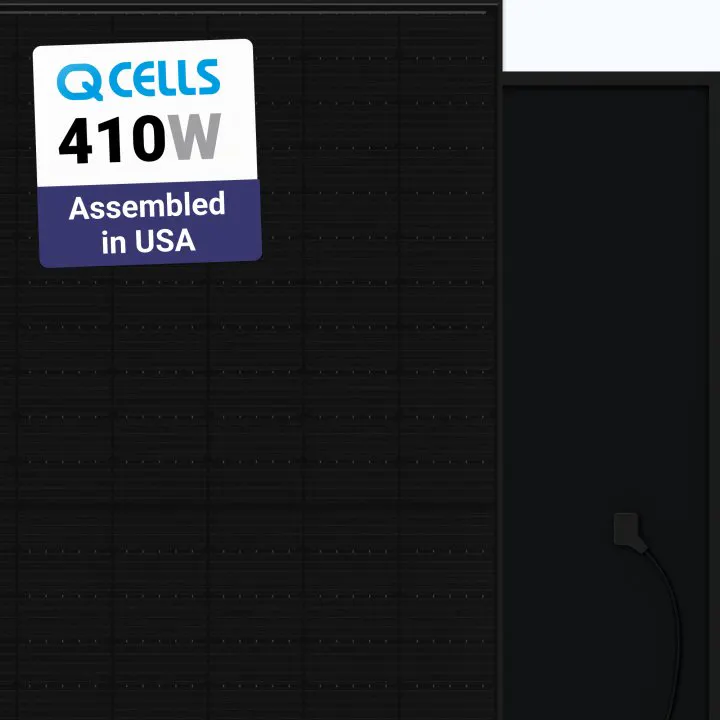
A good example of where that technology lands today is the Q.PEAK DUO BLK ML-G10 410W, QCELLS' current flagship residential panel, which pairs half-cut Q.ANTUM cells with a zero-gap layout for improved output and a clean all-black finish.
Q.PEAK DUO BLK ML-G10 410W
Key Features
- Cell Type
- 132 half-cut Q.ANTUM cells
- Power Output
- 410W nameplate capacity
- Efficiency
- 20.9%
- Max System Voltage
- 1000V DC
- Connectors
- MC4
A high-efficiency all-black residential panel from Q CELLS, built on half-cut Q.ANTUM cell technology and a zero-gap cell layout. At 20.9% efficiency and one of the industry's lowest temperature coefficients, it's designed to hold output well in hot climates while keeping a clean, uniform black appearance.
Pros
- ✓High 20.9% efficiency reduces panels needed per install
- ✓Low temperature coefficient (0.04% loss per 1.8°F over 77°F), strong hot-climate performance
- ✓Slow degradation, no more than 2% year one, 0.50% annually after
- ✓Weather-rated to 5400 Pa front, 3600 Pa rear load
- ✓Clean all-black finish with thinner interconnect wires
Cons
- ✗Lower max system voltage (1000V) than newer TOPCon competitors
- ✗410W output is modest next to higher-wattage full-size cell panels
*Affiliate link — we may earn a commission at no extra cost to you.
Canadian Solar is a publicly traded company and one of the world's largest solar manufacturers, with a global manufacturing footprint that includes facilities outside China as well as within it, giving it a different cost and supply chain profile than some Asian-only competitors.
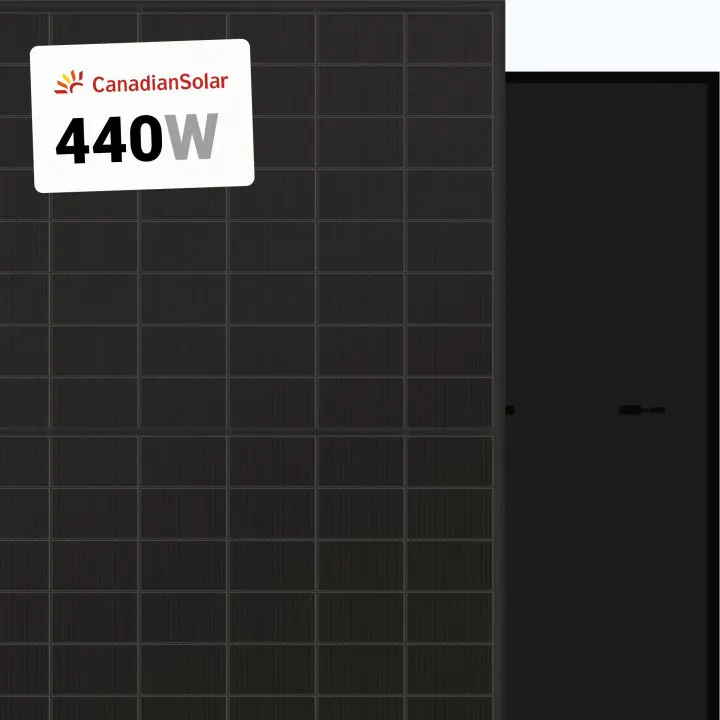
Its TOPHiKu6 series represents the newer generation of its lineup, and the CS6.2-48TM-440 is a strong example, using full-sized TOPCon cells to push efficiency and power output higher than most comparable 400w-class panels.
Canadian Solar CS6.2-48TM-440
Key Features
- Cell Type
- 96 full-sized TOPCon cells
- Power Output
- 440W
- Efficiency
- 22.0%
- Max System Voltage
- 1500V DC
A full-size, high-wattage panel from Canadian Solar's TOPHiKu6 series using TOPCon cell technology. At 22.0% efficiency and 440W output, it's built for strong energy yield per square foot, with a 30-year performance warranty and certification against harsh environmental conditions.
Pros
- ✓Higher efficiency (22.0%) and output (440W) than most comparable panels
- ✓Very low degradation, under 1% year one, 0.4% annually after
- ✓Higher mechanical load rating: 8100 Pa front, 5600 Pa rear
- ✓Certified against PID, salt, acid, and ammonia exposure
Cons
- ✗Slightly higher temperature-related efficiency loss than Q CELLS (-0.29% per 1.8°F vs -0.04%)
- ✗Higher max system voltage (1500V) may need compatible inverter/equipment check before install
*Affiliate link — we may earn a commission at no extra cost to you.
Technology & Manufacturing
Both brands use monocrystalline cells, but their cell architecture differs. QCELLS relies on half-cut Q.ANTUM cells, which reduce resistive losses and improve low-light performance.
Canadian Solar's TOPHiKu6 series uses full-sized TOPCon cells, a newer solar cell technology that pushes efficiency higher than standard PERC designs.
Both companies run highly automated production lines with multiple in-line quality checks, which keeps warranty claim rates low across both brands.
Performance & Efficiency
Efficiency is one of the clearest points of separation. The Q.PEAK DUO BLK ML-G10 410W rates at 20.9% efficiency, while Canadian Solar's CS6.2-48TM-440 reaches 22.0%, a meaningful gap for homeowners with limited roof space.
Temperature coefficient matters too: QCELLS loses just 0.04% of efficiency per 1.8°F above 77°F, noticeably better heat-resistant performance than Canadian Solar's -0.29% figure, which can matter more in consistently hot climates than the raw efficiency number does.
Durability & Reliability
Degradation rates favor Canadian Solar slightly on paper. The CS6.2-48TM-440 loses no more than 1% output in year one and 0.4% annually after that, retaining at least 87.4% after 30 years. QCELLS guarantees a maximum 2% drop in year one and 0.50% annually after, retaining 86% after 25 years. Both panels are rated for harsh weather conditions, including high winds and heavy snow loads, with Canadian Solar's frame rated slightly higher for mechanical load (8100 Pa front versus QCELLS' 5400 Pa).
Warranty & After-Sales Support
Both brands offer a 25-year product warranty, but performance warranty terms diverge: Canadian Solar extends its performance warranty to 30 years, while QCELLS covers 25 years. Longer performance warranties translate to more peace of mind over the life of a residential solar installation, though actual claims experience often depends more on your local installer's service network than the manufacturer's paperwork.
Price & Value
Canadian Solar panels typically land at a slightly lower cost per watt than QCELLS, largely due to lower labor costs at some of its manufacturing sites and competitive pricing strategy across its full-size cell lineup. QCELLS, as a South Korean and non-Asian-adjacent manufacturer for the US market, often prices at a premium tied to its brand reputation and consistent domestic assembly options. For homeowners, the better value call depends on whether the priority is lower upfront cost per watt or the marginally better warranty value and reliability track record QCELLS offers.
Bankability & Industry Reputation
Both companies rank among the most bankable solar manufacturers globally, a critical factor for financed residential systems and utility-scale solar projects alike. Canadian Solar's scale and public listing give it strong standing in commercial system procurement, while QCELLS is frequently cited by installers for consistent product quality and low field-failure rates. Reviews from solar installers generally rate both brands favorably, with SunPower and a handful of other manufacturers rounding out the top tier alongside them.
Environmental & Sustainability Practices
Both companies publish sustainability commitments and pursue certifications tied to responsible sourcing and manufacturing practices. Canadian Solar has invested in energy storage solutions alongside its panel lineup, positioning it as a broader renewable energy company rather than a pure panel manufacturer. QCELLS has similarly expanded its energy solutions offerings, and both companies participate in industry recycling initiatives for end-of-life panels.
How to Choose Between QCELLS and Canadian Solar
- Budget-conscious buyers will likely find Canadian Solar's lower cost per watt more attractive, especially on larger installations where the per-panel savings add up.
- Performance-focused buyers may lean toward Canadian Solar's higher efficiency and longer performance warranty, or toward QCELLS if installing in a hot climate where temperature coefficient matters more than peak efficiency.
- Sustainability-focused buyers should compare each company's current recycling and sourcing disclosures directly, since these programs evolve regularly.
If you're pairing either brand with an off-grid or hybrid battery setup, confirm your MPPT charge controller can handle the panel's voltage and current output, and check that your chosen inverter is compatible with the panel's max system voltage (1000V for QCELLS, 1500V for Canadian Solar).
Ask the installation company about local stock, workmanship warranty terms they offer separately from the manufacturer, and which brand they have the most field experience installing and servicing.
Conclusion
QCELLS and Canadian Solar are both credible choices among the world's largest solar manufacturers, and choosing the right pick depends on what you're optimizing for. Canadian Solar generally wins on efficiency, degradation rate, and price per watt, while QCELLS holds an edge in hot-climate performance and a slightly longer track record of field reliability data.
Whichever you choose, confirm the exact spec sheet for your chosen model, since performance can vary by product line within each brand.
FAQ
- Which is more efficient: QCELLS or Canadian Solar?
- Canadian Solar's TOPHiKu6 panels generally edge out QCELLS on efficiency, but this varies by model, so always check the specific datasheet for the panel you're considering.
- Which brand offers better warranties?
- Both offer 25-year product warranties. Canadian Solar's performance warranty runs 30 years versus QCELLS' 25 years, though service network quality often matters as much as warranty length.
- Are QCELLS or Canadian Solar panels better for hot climates?
- QCELLS panels typically have a lower temperature coefficient, meaning less efficiency loss in high heat, making them a strong choice for consistently hot regions.
- Which brand is more reliable for large commercial projects?
- Both are considered bankable for utility-scale solar, with Canadian Solar's scale and public listing giving it a slight edge in large commercial and institutional projects.
- How should I compare price and value between the two brands?
- Compare cost per watt alongside expected energy yield, degradation rate, and warranty terms rather than sticker price alone, and get quotes from your installer for both brands on your specific project.